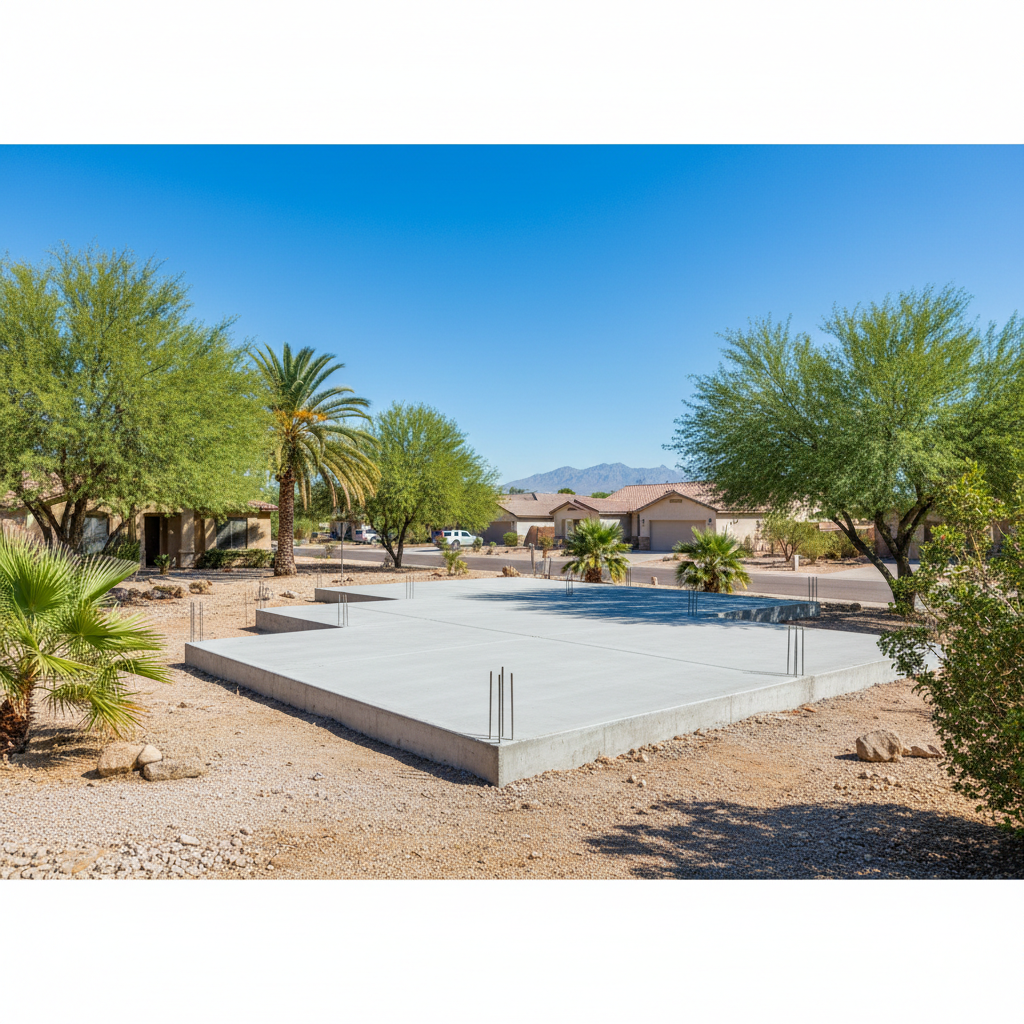
Your house is only as strong as what is holding it up, and out here in Laveen Village, that means dealing with some unique ground conditions. If you have lived around Laveen Village long enough, maybe out near 51st Avenue or down close to the Gila River bend, you already know our soil is not like what you would find back east. We deal with heavy caliche, expansive clay, and desert dust that packs down hard until it gets wet. When you are pouring a Concrete Foundation for a new build, an addition, or even a heavy workshop out back, you cannot just guess at the mix or skip the proper prep work.
Most homes in Laveen Village sit on monolithic slab foundations. It is a method where the footings and the slab get poured all at once, making a single, solid piece of concrete that spreads the weight of the house across our unpredictable desert earth. But the ground underneath moves. When we get those heavy monsoon downpours in July and August, water sinks down and swells up the clay. Then, the scorching 115-degree summer sun bakes it all dry again, shrinking the soil right back down. That constant shifting puts massive stress on Concrete. If your site is not graded right and compacted correctly before the truck even shows up, you are going to see cracks running across your floors much sooner than you should.
Why Local Experience Matters
Kingdom Concrete Laveen has seen plenty of out-of-town contractors try to apply generic building rules to Laveen Village, and it rarely ends well for the homeowner. They do not account for how fast concrete flashes cures when the dry wind is blowing across the open fields. If you do not know how to adjust your water-to-cement ratio or time your finishing work right, the top layer dries out too fast while the bottom stays soft. That leads to dusting, scaling, and structural weakness.
Kingdom Concrete Laveen spends our days working right here in Laveen Village neighborhoods. Kingdom Concrete Laveen knows how the soil behaves in the newer subdivisions compared to the older acreage lots. Our team knows that rebar placement needs to be spot-on to handle the thermal expansion we get during peak summer. Cutting corners on a Foundation to save a buck today is the fastest way to invite thousands of dollars in wall cracks and misaligned doors down the road.
Getting the Prep Work Right
A good Foundation pour actually starts days before the concrete ever arrives. First, the site has to be cleared of organic matter and graded so water drains away from your living space, not toward it. Then comes the sub-base compaction. We roll and tamp that desert dirt until it is stable and dense. Skipping this step is the number one mistake bad contractors make because they want to rush to the fun part.
Our team also pays close attention to moisture barriers and vapor retarders underneath the slab. Laveen Village ground moisture can push up through unsealed concrete, bringing alkaline salts with it that will ruin your flooring adhesives and cause mold issues. Putting down a heavy-duty vapor barrier stops that moisture dead in its tracks.
Once the forms are locked in and the steel grid is tied down tight, the pour has to move like clockwork. We work fast, screed it flat, and make sure it is properly edged and finished. After the concrete sets up, curing is everything. We keep it damp or use curing compounds so it gains its full structural strength instead of drying out too fast in this desert air. For homes and businesses in Laveen Village, Kingdom Concrete Laveen provides Concrete Foundation services.